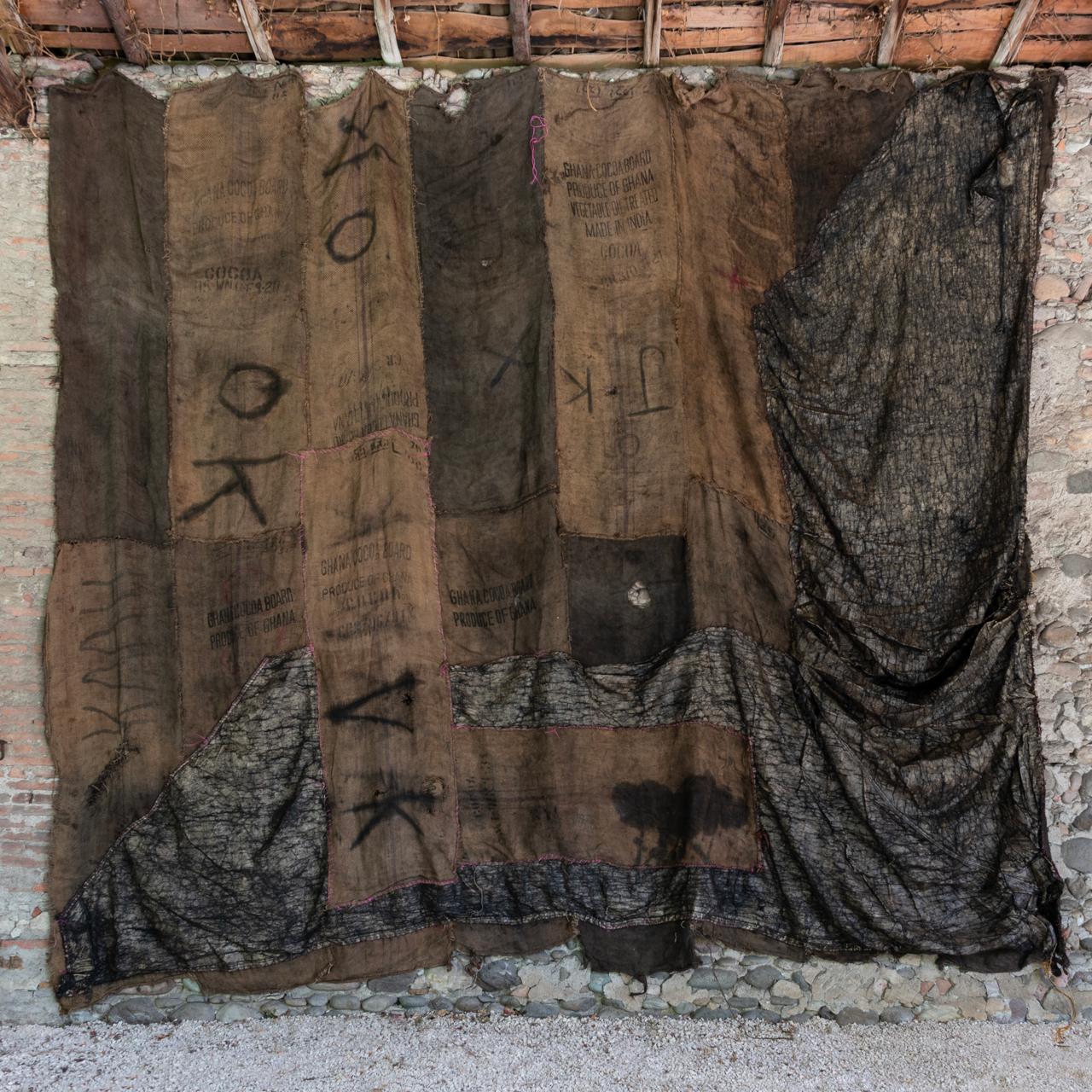


Untitled
Description:
Ibrahim Mahama (b. 1987, Tamale, Ghana) is an artist whose practice is grounded in the use of reclaimed materials — jute sacks, metal sheeting, railway sleepers — sourced from markets, ports and industrial sites across Ghana, which he assembles and stitches together into vast textile surfaces used to envelop buildings and institutions around the world, from the Venice Biennale to Documenta. Through these interventions, the residue of postcolonial economies is transformed into expressive matter charged with precise political meaning, its woven surfaces carrying within them the traces of the global circulation of goods and the labor conditions that accompany it.
Untitled takes the form of a composition of worn jute sacks and fragments of tarpaulin stitched together, their surfaces retaining original markings — including “Ghana Cocoa Board – Produce of Ghana” and “Made in India” — alongside tally marks and handwritten annotations that turn the fabric into a kind of involuntary register of the journeys and hands it has passed through. The Ghana Cocoa Board emblem refers to the governmental body responsible for managing Ghana’s cocoa, one of the country’s principal export commodities, its trade being embedded within a network of global exchange that perpetuates patterns of economic dependency rooted in colonialism. Positioned above the entrance to the Collection of African Arts and Cultures, the work functions as a programmatic statement, greeting visitors from the very threshold and asserting the vitality and contemporary relevance of African visual languages through the voice of one of the most authoritative artists on the international scene — inviting them to view the Museum’s historical holdings through the critical lens of the present. ML