

Tradição amazônica (Amazonian Tradition)
Description:
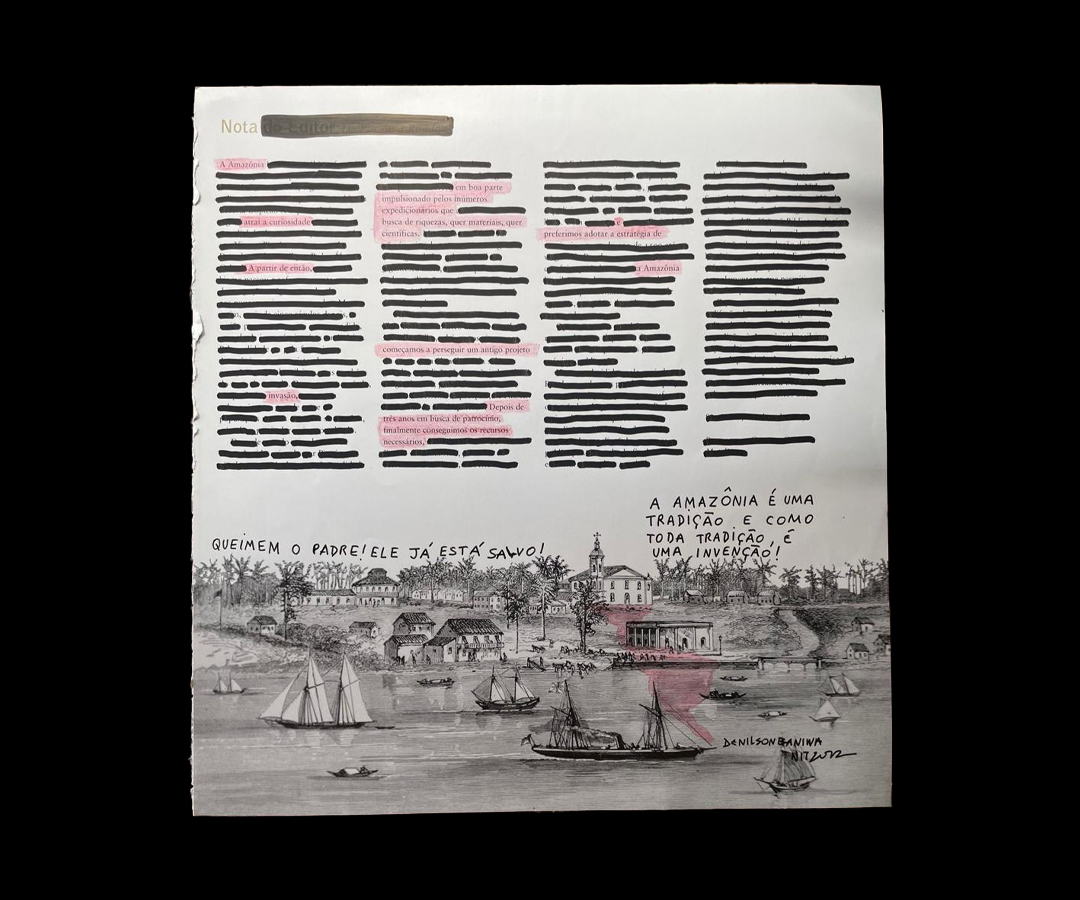
Denilson Baniwa (1984, Barcelos, Brazil) is a Brazilian artist of Baniwa origin whose practice brings together painting, performance, video, installation, and activism. His work critically rereads the colonial imagery produced about the Amazon and Indigenous peoples, often appropriating historical images, maps, engravings, and museum languages. Tradição amazônica (Amazonian Tradition) is a work developed from a page torn from a textbook used in Brazilian schools, one that perpetuates the idea that Amazonian cultures belonged solely to the past and were to be surpassed through the Catholic and colonial ‘civilizing work.’ The selected page discusses the descimentos—the forced relocation of Indigenous peoples from the Amazon to labor in extractive industries, under regimes that exploited both their labor and knowledge, as well as the region’s natural resources. Baniwa manipulates and transforms the page’s layout by obscuring most of the text with dense black redactions, leaving only a few words legible, chosen to form a new poetic and reflective phrase. In the lower portion of the page, he intervenes on an illustration of a nineteenth-century river landscape with boats, colonial buildings, and a church, over which he handwrites two phrases that dominate the scene: “Queimem o padre! Ele já está salvo!” (“Burn the priest! He is already saved!”) and “A Amazônia é uma tradição e, como toda tradição, é uma invenção” (“The Amazon is a tradition and, like every tradition, it is an invention”). The erasure of the text becomes a restorative gesture, symbolizing the cultural erasure produced by colonization and exposing how the notion of an ‘Amazonian tradition’ functions as a homogenizing construct. This occurs within a context that still today includes the resistance of around 400 Indigenous cultures, 100 of which remain ‘uncontacted’ or isolated from the rest of the world. ML