

Vegetal Dress
Description:
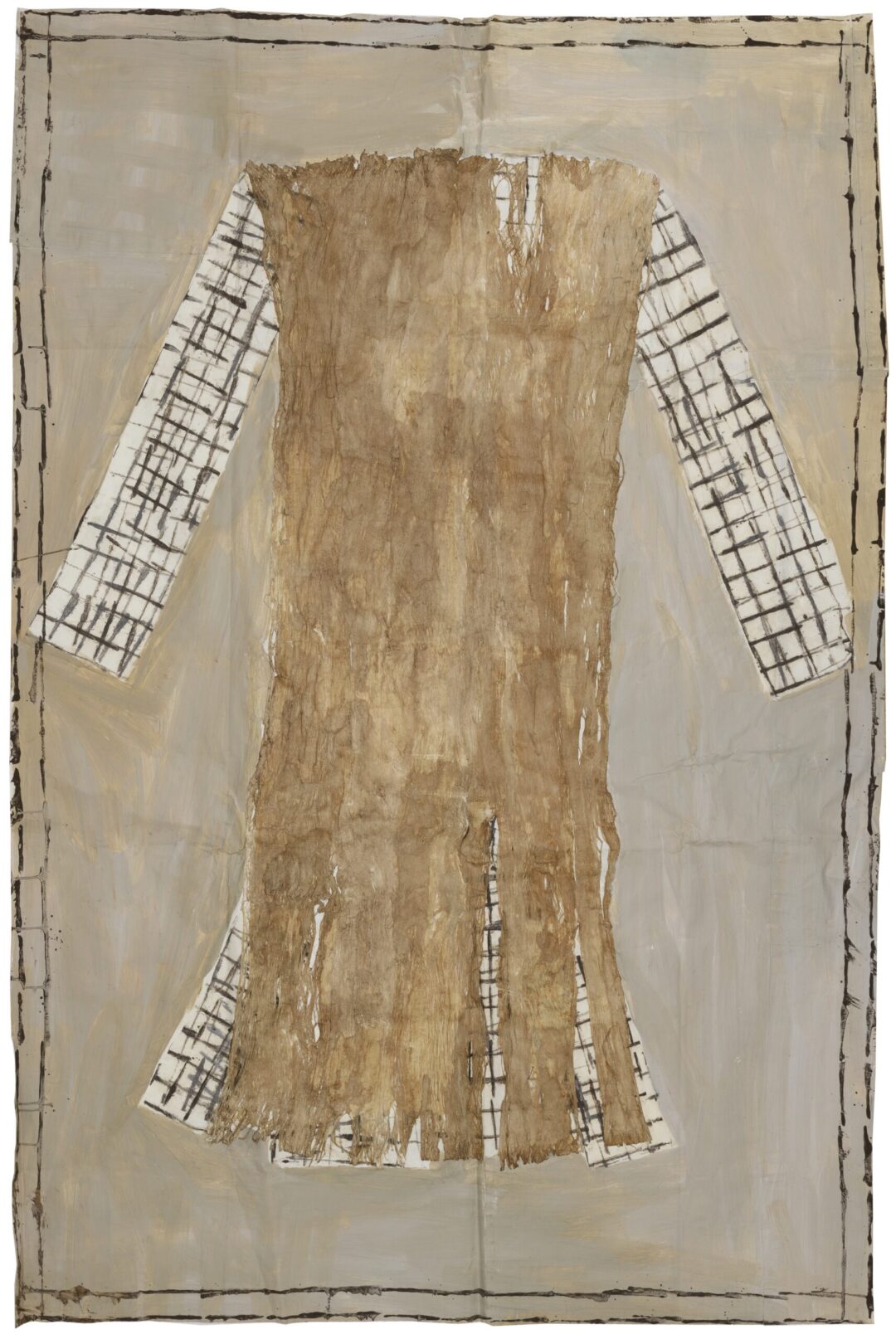
Abito Vegetale belongs to the Abiti series, in which Isabella Ducrot assembles antique fabrics of different origins; here, in their place, the artist uses tree bark. For Ducrot, fabric has never been decoration but, in her own words, a “complex artifact whose invention dates back to mythical ages of human history,” a document that declares “tastes, aesthetic rules, migrations of signs, visible and tactile testimonies of a culture.” The bark recalls, in this case, the process by which tapa are produced in Polynesia – fabrics made of tree bark, macerated and beaten with mallets in order to compress the fibers together until they become thin and flexible, of which the Oceanian Arts and Cultures Collections at MUCIV–Museum of Civilizations preserve over one hundred examples. In the work, this material becomes the body and, at the same time, its garment: a form that, like fabric in general, or the skin of the body, is not exhausted by everyday function but can also become a language of evocation, encounter and dialogue with the sacred. If weaving, as the poet Patrizia Cavalli wrote of Ducrot‘s work, is an entirely human invention, “a marriage that could not in nature ever find its place,” for Ducrot this means opening to dialogue not only between cultures, but to the ancestral dialogue between culture and nature. In Abito Vegetale this dialogue takes place between a vegetal material, bark, and the pigment laid down by the artist on paper: a direct dialogue of which the materials, techniques and textile traditions held in MUCIV’s historical collections offer a magnificent, encyclopedic demonstration, spanning (weaving together) millennia, territories, beliefs and species. AV