

Suivre ses Rêves (Following One’s Dreams)
Description:
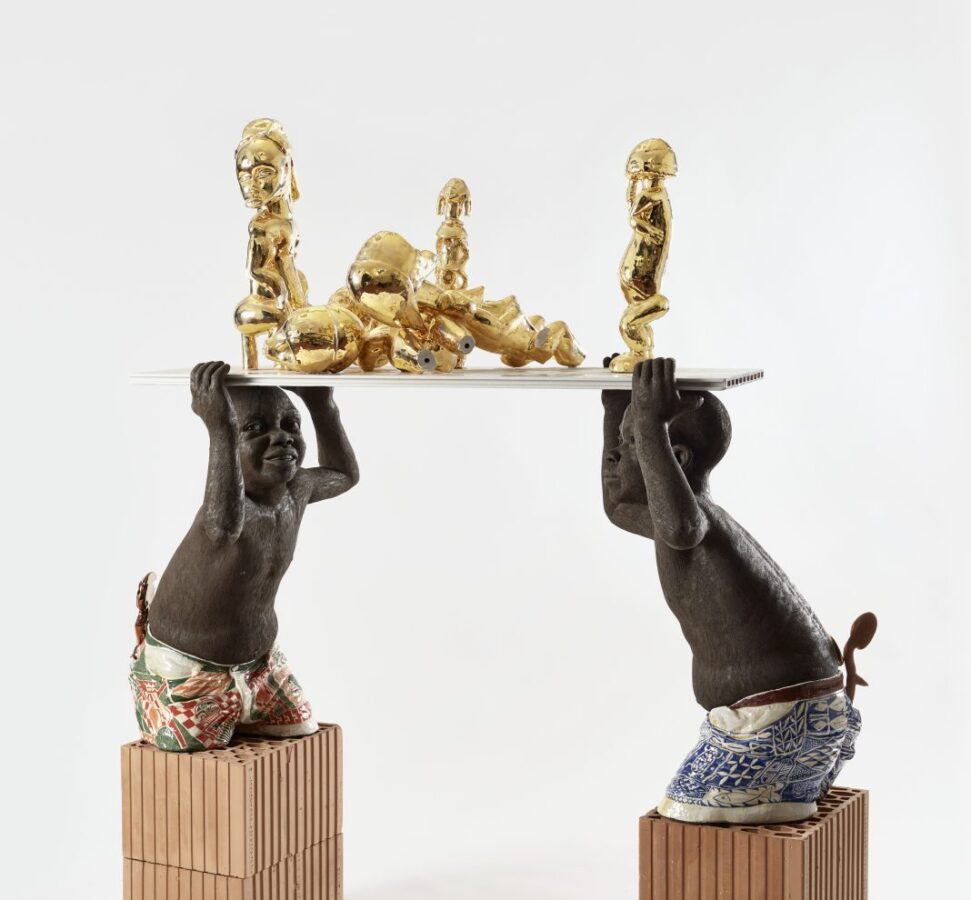
Victor Fotso Nyie, Suivre ses rêves
Victor Fotso Nyie (b. 1990, Douala, Cameroon) is an artist whose practice intertwines sculpture, ceramics and installation, examining the condition of contemporary African man — shaped by the unresolved consequences of colonial exploitation and dispossession. Initially trained at the Institut de Formation Artistique in Mbalmayo, Cameroon, he moved to Italy in 2012, where he earned a diploma in mosaic art at the Accademia di Belle Arti in Ravenna, specialized in ceramics at the Istituto Tecnico Superiore in Faenza, and completed a two-year sculpture program at the Accademia di Belle Arti in Bologna. His research centers on the symbolic reclamation of African cultural heritage scattered across European museums and markets, through works in which the hyperrealist modeling of the human figure — rooted in the Western tradition — merges with the forms of sub-Saharan African statuary and with the ceramic techniques and gilding characteristic of the artistic traditions of Faenza and Ravenna, generating a hybrid, transcultural sculptural language.
Suivre ses rêves (Follow your dreams) is a polychrome ceramic sculptural group depicting two children — inspired by the artist’s twin brothers — carrying a table laden with small gilded sculptures that evoke the ritual objects of sub-Saharan Africa. The figures are modeled with a careful, empathetic naturalism that conveys both the physical strain of the effort and the determination of those carrying out a necessary task. The small statuettes the two brothers carry recall ceremonial objects, power figures and sacred sculptures — like those on display in this room — that for centuries served as mediators between the visible world of the living and the invisible world of ancestors and deities, and that campaigns of colonial dispossession stripped from African communities, severing the bond between these objects and the systems of care, protection and balance of which they were an integral part.
The dream evoked in the title is a recurring element in Fotso Nyie’s artistic vision, which he conceives as a space-time of imagination and possibility in which to envision a different future: the gesture of the two children thus takes shape as both a dreamlike and a political act of reclamation, in which new generations literally take up the weight of their own cultural heritage, carrying it forward toward a horizon of meaning and belonging. The work is integrated into the itinerary of the room, in whose reinstallation the artist himself collaborated — proposing that the historical objects held by the Museum might be transformed from testimonies of rupture and dispossession into instruments of new equilibrium, capable of setting in motion a reparative gesture through the reconstruction of shared memories and identities. ML