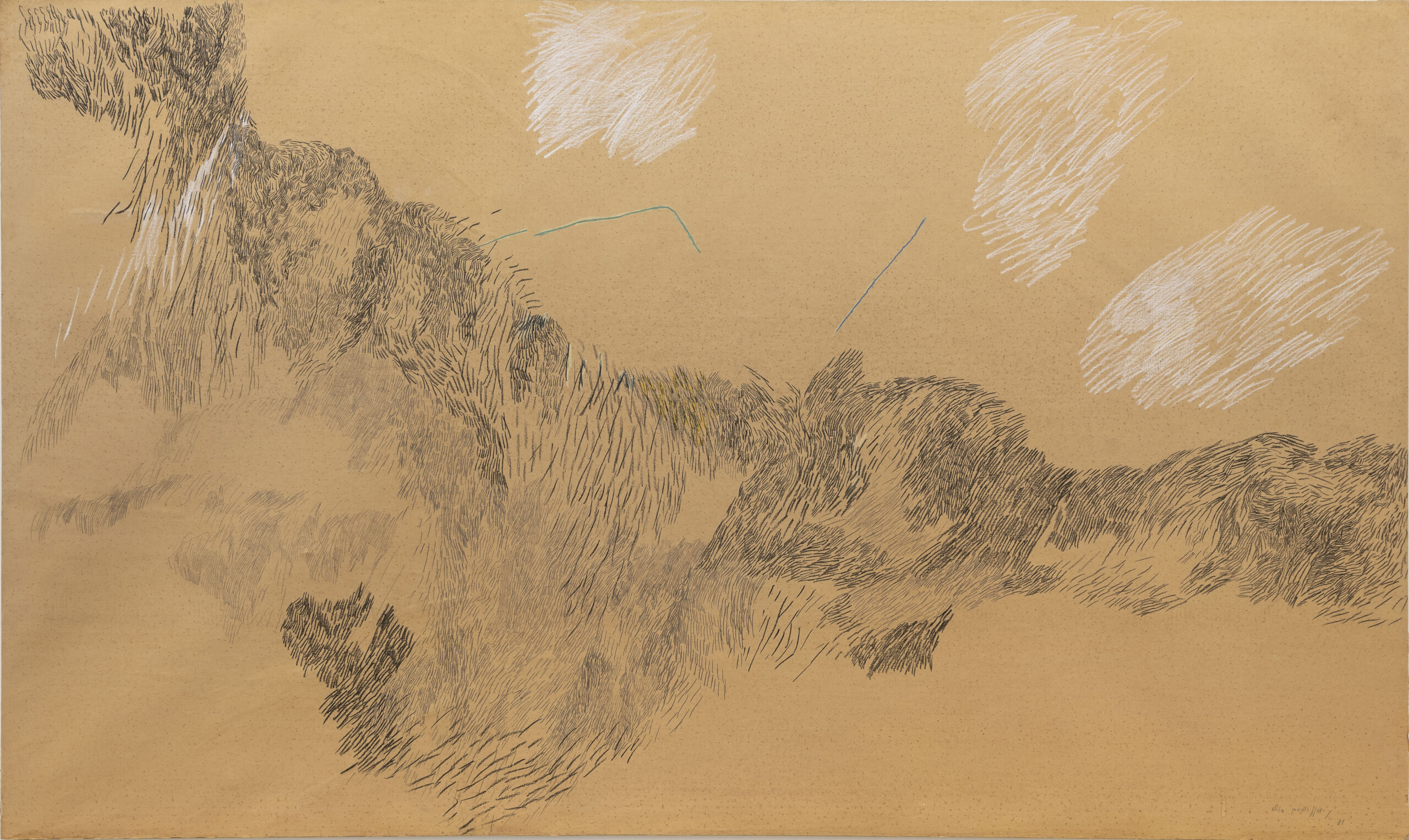


Paesaggio della Manciuria (Manchurian Landscape)
Description:
In the research of Elisa Montessori (Genoa, 1931) multiple references, techniques and subjects are simultaneously and non-exclusively articulated. Trained in the 1950s in the Roman studio of Mirko Basaldella and coming into contact with the artists of the Gruppo Origine (Alberto Burri, Giuseppe Capogrossi, Ettore Colla), Montessori defines a personal practice in which painting and drawing, ceramics and engraving, the use of charcoal, chalk, pastel, egg tempera and multi-material insertions—of both natural and artificial origin—seem to complement each other. In her works—in which, starting from the 1980s, the relationship between text, of poetic and literary origin, and image is explored in a spiral of personal diaries-leporellos-notebooks—the reference to non-European arts and cultures, particularly Asian ones, is a constant source of inspiration. Paesaggio della Manciura (Landscape of Manchuria) is part of the group of canvas paper large-scale works—together with La Montagna di Seghers (The Mountain of Seghers) and Le Terre dei Masai (The Lands of the Maasai)—which was first exhibited at the XL Venice Biennale in 1982, where the artist was invited by critic Tommaso Trini in the Aperto section. As the artist herself said: “I usually worked on small formats, but at a certain point I decided to move to much larger formats. The idea was simple: mark after mark, the landscape grows and becomes immense. I chose to use empty space as if it were a full part, creating a distance between what is drawn and what is left blank so to give equal value to both—as in music, where silences are just as important as the notes: silence becomes music as if it were sound. This way of thinking derives from an “Oriental” vision: the void is not absence, but presence. I created symbolic marks, similar to V shapes, as if they were flights or flying traces. The title itself becomes part of the work: I choose imaginary geographic names, distancing myself from daily reality. For instance, I’ve never seen the Maasai, nor have I ever been to Manchuria… The landscape becomes imaginary, not a naturalistic try but rather a willingness to look elsewhere. Technically, the work is made on mounted paper on canvas in the form of a scroll—a format that, in “Oriental” tradition, is mysterious, secret, ancient. It’s the testimony of something that opens and closes. I’ve never thought of a painting as just an object to hang on a wall, but rather as a field of energy where anything can happen: thus, I felt the need to open the scroll and exhibit it. It is composed of pounce paper, graphite, acrylic gesso: a simple technique, like the material used. Pounce paper is a humble material that painters used in the past to transfer drawings onto walls: they would perforate the drawing and dust it with powder to leave a dark outline on the wall, revealing in this way the drawing that would generate the fresco. That is, I’ve always worked “in reverse”— focusing on the shadow of things, on invisible traces.” AV