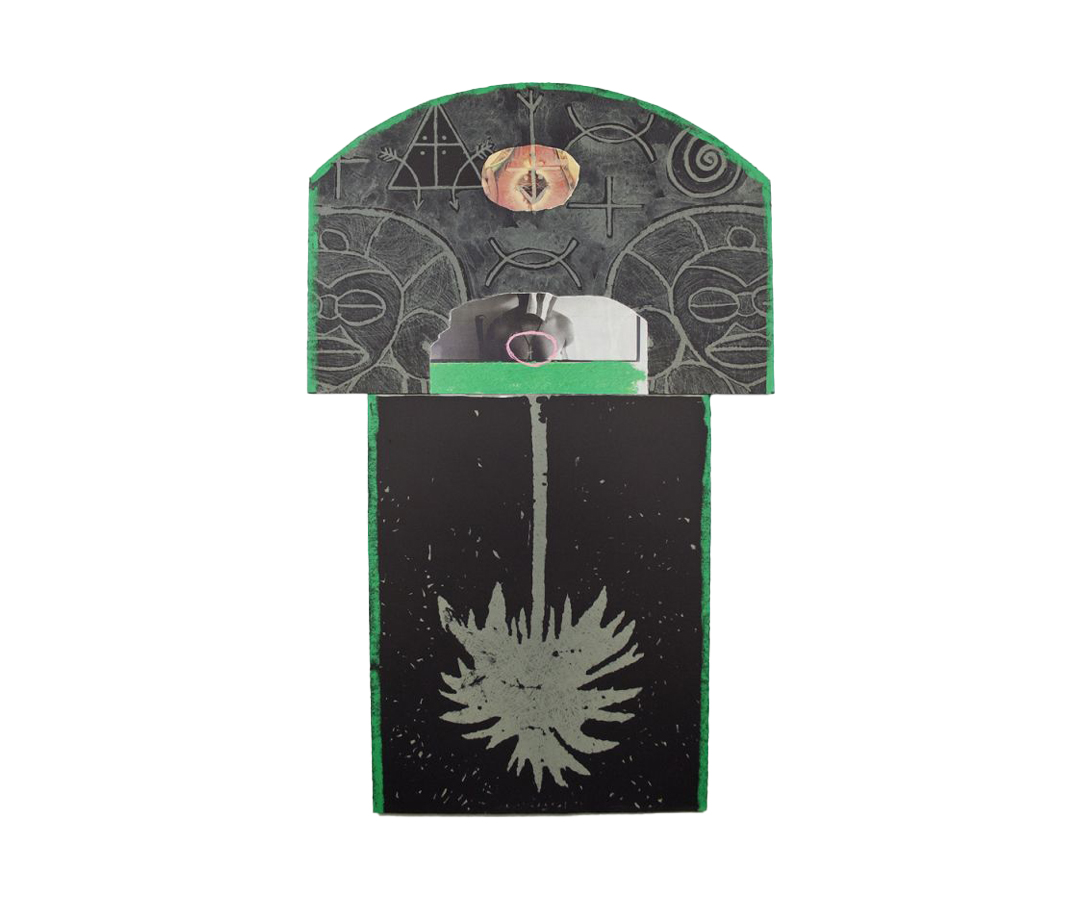


Afro-Taino
Description:
Juan Sánchez (1954, Brooklyn, New York), a Nuyorican artist born in Brooklyn to Puerto Rican parents, works across painting, photography, printmaking, collage, video, and mixed media. His practice intertwines personal memory, diasporic identity, the colonial history of Puerto Rico, and political activism, making his art a space of resistance and cultural affirmation. Afro-Taino is a work that weaves together memory, identity, and resistance, standing as a visual manifesto for the cultural complexity of Puerto Rico and, more broadly, the Caribbean and Latin American diaspora. The work combines painting, collage, photography, and text in a layered language that brings together African, Indigenous, and Christian symbols, reflecting the multiplicity of roots that shape Caribbean history. The lithograph takes the form of a secular altar, where sacred Taíno imagery (referring to the Indigenous peoples of the Antilles) merges with references to Afro-diasporic culture and symbols of Puerto Rican political resistance. These visual and semantic overlays create a hybrid language capable of conveying the complexity of Creole identity and its ongoing processes of reconstruction. Sánchez reworks the historical legacy of colonialism and slavery through a syncretic aesthetic composed of fragments of faces, maps, texts, and colors that coexist to evoke the histories of contact between Taíno communities and enslaved African populations as a network of connections and cultural survivals. In this sense, Afro-Taino becomes an act of affirmation and redemption: an image that celebrates the heritage of those who—though marked by colonization—continue to generate artistic forms of freedom from their plural roots. ML