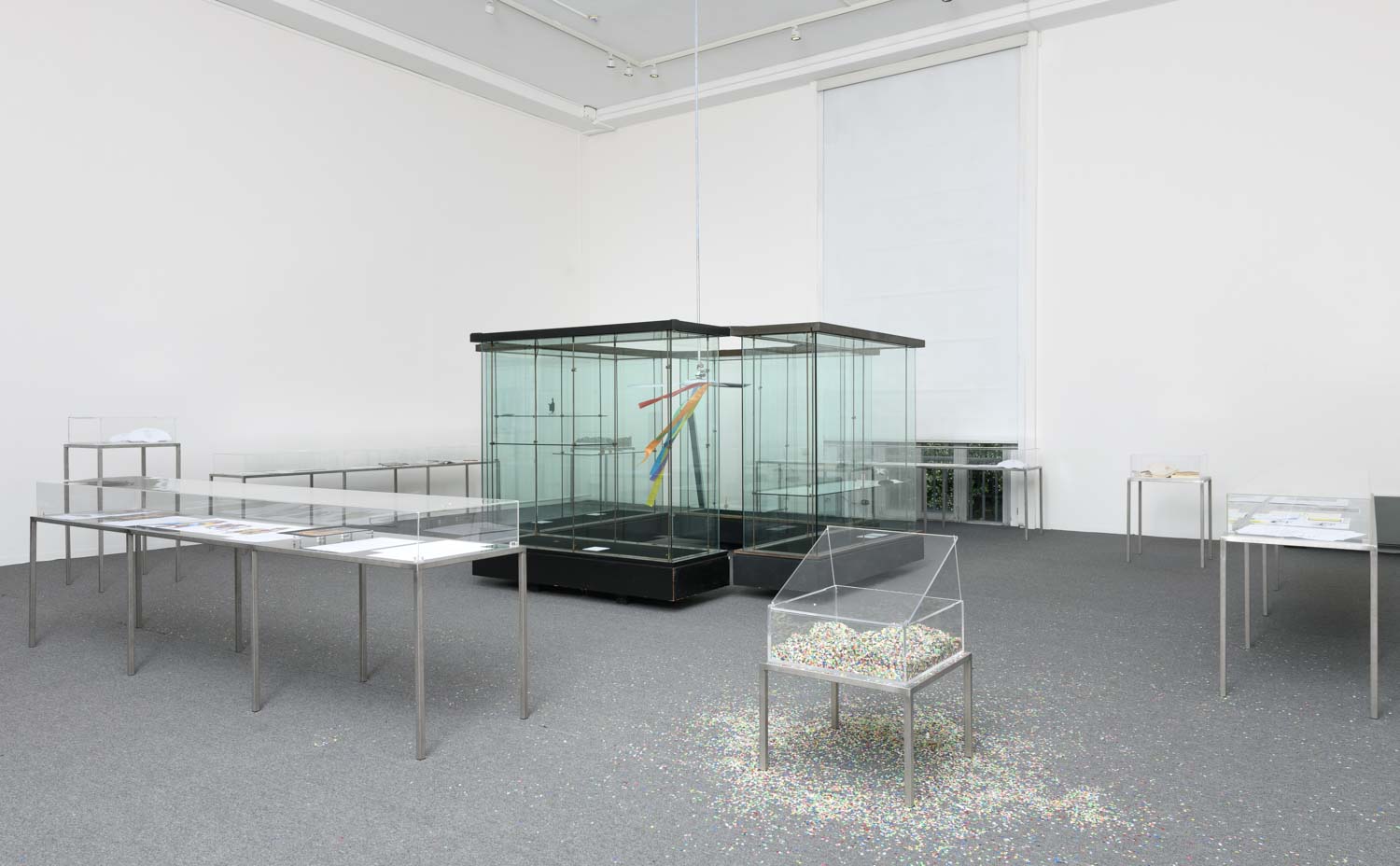


giganti miniature
Description:
giganti miniature is the outcome and final intervention of Bruna Esposito’s Research Fellowship at the MUCIV – Museum of Civilizations. It consists of the sharing of 16 projects, understood not so much as unrealized works, but as open hypotheses, entrusted to the reflection of the museum and its audiences. Evoking the ancient festival of Carnival, the artist proposes possible subversions of the rules that traditionally organize the paths and methods of research, cataloging, exhibition, and storytelling within the museum—just as Carnival traditionally invokes a temporary suspension of conventional norms and social hierarchies. The title itself, formed by the paradoxical pair of giants and miniatures, invites reflection on the monumentality and historical responsibility of the Museum of Civilizations’: the actual giants in which the Museum operates were built for the never-inaugurated 1942 Universal Exhibition of Rome (EUR), and over time have become the custodians of more than 2,000,000 objects and documents—often infinitesimally small, and at times even immaterial. Exploring this paradox, the artist’s 16 projects reflect on the potentialities and controversies of a contemporary ethnographic-anthropological museum, with a scale oscillating between the macroscopic and microscopic, the visible and invisible, the known and unknown, the affirmed and the omitted. The exhibition layout is also centred on a double geometric figure. The first is that of the square, which recalls the Italian expression “fare quadrato”, meaning to come together to collectively protect someone or something. It is articulated through four historical museum display cases positioned at the center of the installation—housing some of the smallest and most fragile artifacts in the collections—and in the four groups of cases that contain sketches, documentary images, and texts by the artist. The second figure is the circle, activated by the movement of a fan hanging from the ceiling in the center of the installation, to which colored plastic strips are attached. These strips lightly touch the museum display cases, highlighting their role as barriers and agents of control. Among the hypotheses Esposito has formulated for the Museum, the only one already adopted is the proposed donation to the Collections of Folk Arts and Traditions of the allegorical float Pace Armata, made in 2023 by master Alessandro Avanzini for the 150th edition of the Viareggio Carnival—an event that is both an intangible tradition and a material manifestation of popular art. ML-AV