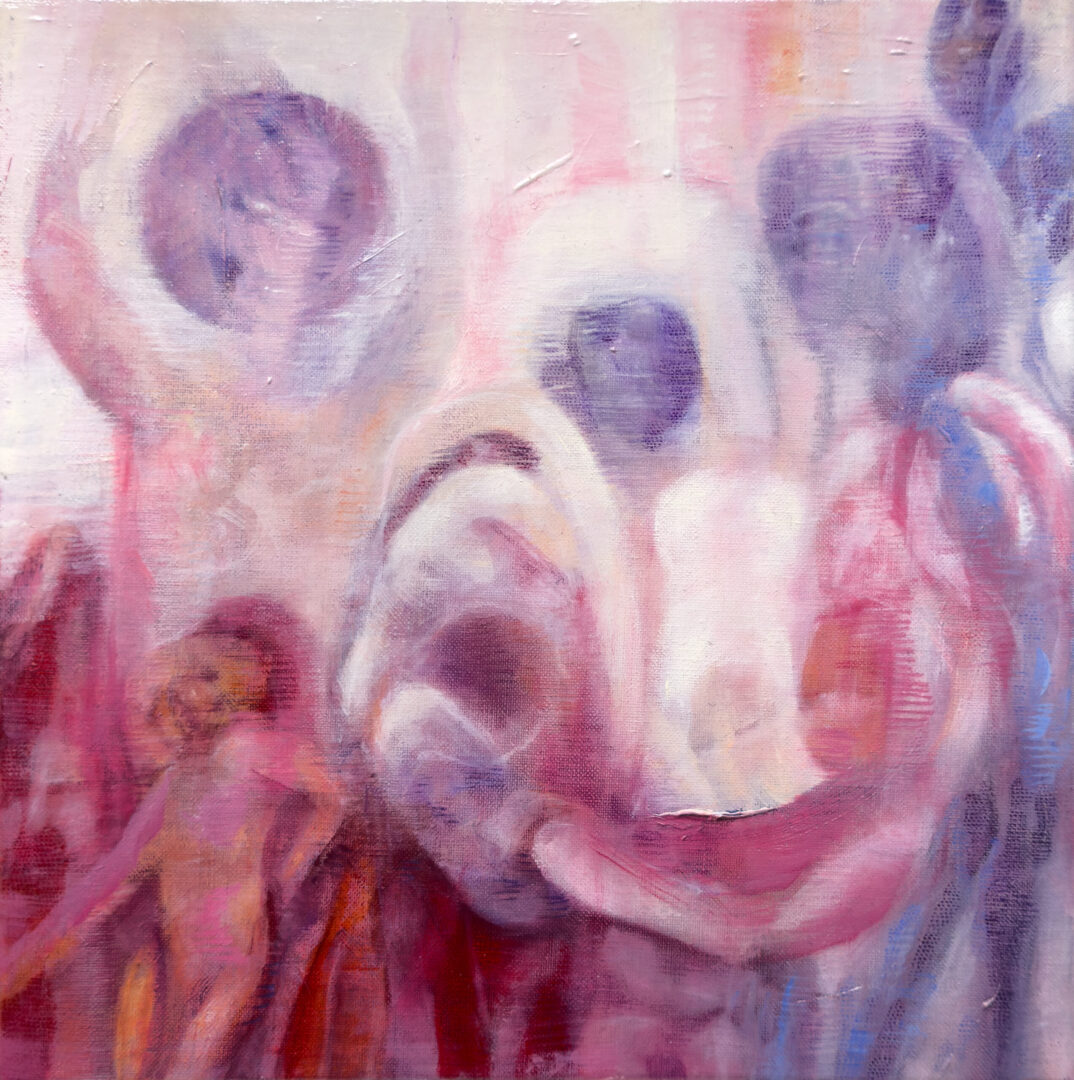


Angel of Carriance I
Description:
Artist, feminist philosopher and theorist Bracha L. Ettinger (Tel Aviv, 1948)—who also adopts her first name BRACHA in her artistic practice—employs various means such as writing, drawing, and painting, and blends them into an organic continuum. This encompasses philosophical and theoretical texts, fragmentary notes from her notebooks, small drawings and sketches, stains soaked in pure color, and figurations which are at the same time phantasmatic and rich with potential evocations. These daily practices, inseparable from one another, require a slow and laborious production that invoke a biographical and memorial dimension, where art becomes a form of understanding, care and elaboration of trauma—subjective and personal as well as historical and collective. Taken together, her works translate depth and radicality, uniting different matrices which also include psychoanalysis (the artist herself was a psychotherapist). The first public presentation of her pictorial works occurred in the early 1980s, when she rejected figuration and monumentality mostly predominant at the time. From the 1980s, Ettinger also began to develop her work as a feminist philosopher and theorist, with her essays published in 2000 in two volumes edited by Griselda Pollock. The fundamental concept she developed is that of matrixial: a notion which helped to re-found contemporary thought on subjectivity, reinterpreting it from the pre-natal condition in which mother and fetus interact in a process of reciprocal in-becoming. Ettinger also elaborated further concepts and invented neologisms and syntactic constructs that formed an autonomous expressive vocabulary. In this way, she helped to bring about a shift in contemporary Western thought, which is still patriarchal and increasingly inclined towards digital dehumanization. She overcomes the oppositional and binary logics to indicate alternative possible practices of interaction and collaboration: border-linking and border-spacing, co-emergence and co-poiesis, distance-in-proximity and proximity-in-distance, metramorphosis, trans-jectivity and tran-subjectivity, wit(h)nessing. The title of Ettinger’s work Angel of Carriance I refers to one of these concepts. Among human beings—perhaps mothers and children, subtly rendered forms seems to suggest a shared condition of sorrow—the figure of an angel appears. This may be a possible reference to Paul Klee’s 1920 watercolor Angelus Novus and the reflections of philosopher Walter Benjami on it. In this work, Ettinger affirms a sensation in which the very concept of carriance takes form, where the actions of carrying and caring are merged. AV