


Museum of Opacities #2 Colonial Agricultures and Architectures
On Wednesday, May 21st, 2025, the MUCIV-Museum of Civilizations presents Museo delle Opacità (Museum of Opacities) #2. Colonial Agricultures and Architectures is the new chapter of the project, curated by Rosa Anna Di Lella, Gaia Delpino, and Matteo Lucchetti, dedicated to the reorganization and re-displaying of the collections of the former Colonial Museum of Rome, which became part of MUCIV in 2017 and are being re-catalogued.
Consisting of more than 12.000 works and documents that prove the almost centenarian Italian colonial history in Africa (1882-1960), these collections were originally musealised in support of colonial policies but have not been exhibited since the closure of the Colonial Museum in 1971. Therefore, MUCIV involves its public in participating in the reflections around the rearrangement of the collections and the gradual restitutions to the community. In this process, the various chapters of the Museo delle Opacità’s (Museum of Opacities’) project go in-depth on individual aspects and thematic focal points, bringing into dialogue historical evidence with new research, contemporary art interventions, and the involvement of the interested communities.
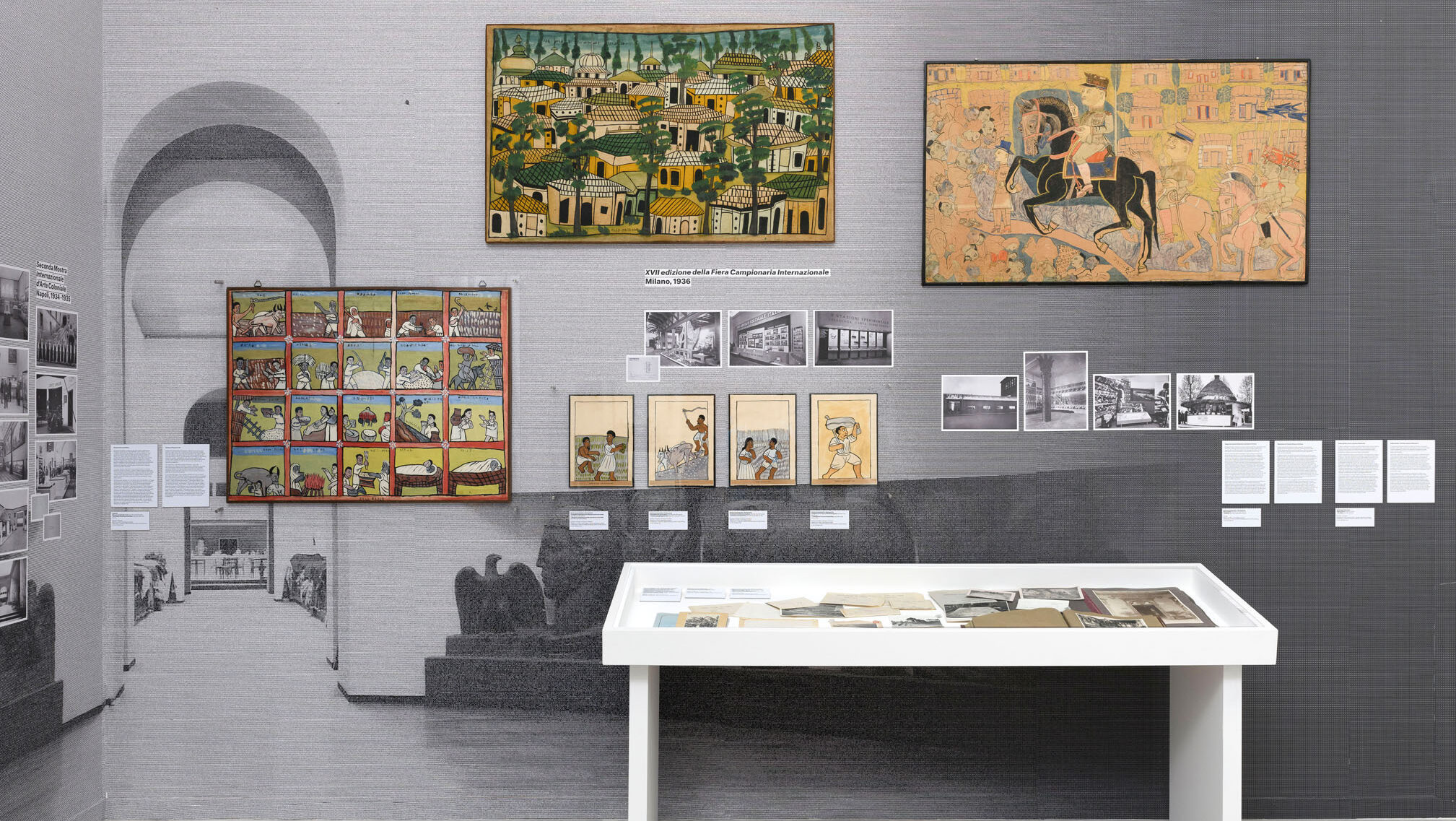
In this second chapter, which follows the one that opened in 2023, the focus is on the relationship between agriculture and colonial architecture analysing – through documents, photographs, and works of art from the era – aspects such as the economic exploitation of human, environmental, and geological, resources, or the relationship between art and propaganda in the history of Italian colonialism in Eritrea, Somalia, Libya, and Ethiopia. Emblematic, in this second chapter, is the selection of photographic documentation of some of the main colonial exhibitions that took place on Italian territory, starting from the International Exhibition of Navy and Marine Hygiene (Esposizione Internazionale di Marina e Igiene marinara) in Genoa in 1914 to the First Triennial Exhibition of Italian Overseas Lands (Prima Mostra Triennale delle Terre Italiane d’Oltremare) in 1940 in Naples, passing through Rome, Milan, and Bari. The documentary funds of the former IsIAO (Italian Institute for Africa and the Orient) also contribute to sharing the ongoing research, which complements the exhibition thanks to the collaboration with the National Central Library in Rome. Some in-depth tools integrate the exhibition path, allowing the selected materials to be contextualised within the more general framework of colonial policies and economies, and a programme of guided tours, educational activities, and public events will offer further moments of discussion.
The connection to the contemporary scenarios is entrusted, in this second chapter, to two installations: Rights to Seeds, Rights of Seeds by Cooking Sections, acquired thanks to the PAC-Piano per l’arte contemporanea by the Italian Ministry of Culture, and Entity of Decolonizations: Ashes, which represents the concluding intervention of the three-year research conducted at the museum by DAAR – Sandi Hilal and Alessandro Petti as Research Fellow. Works of art from the historical collections of the former Colonial Museum include contributions by the artists Domenico De Bernardi, Gariesus Gabret, Laurenzio Laurenzi, Giorgio Oprandi, Yohannes Tesamma, Giustino Varvelli, Teodoro Wolf Ferrari, and Yitbārak, in dialogue with three works from the MUCIV Contemporary Art Collections, by Peter Friedl, Jermay Michael Gabriel, and Adelita Husni-Bey.