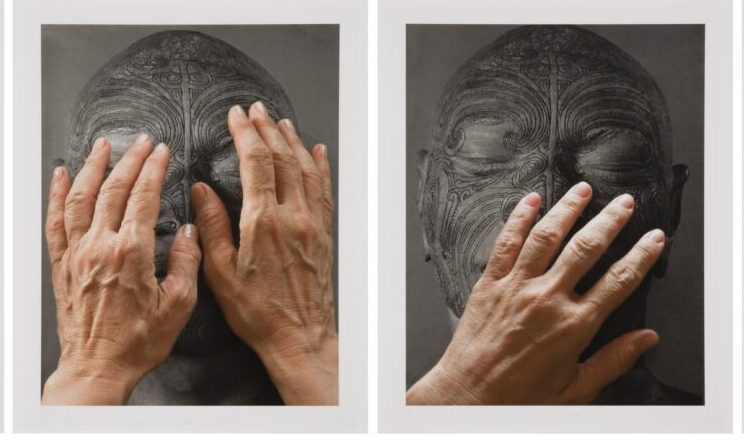


Sem Título (Untitled) from A Flor De Pele
Description:
Born in 1942 in Scalea, Calabria, to an Italian father and an Ecuadorian mother, Anna Maria Maiolino moved to Brazil in 1960, which was to become her new habitat—at once similar and different. These similarities and differences are inherent in the very definition of ‘Latin America,’ which evokes a familiar context for those arriving from Europe, yet is also marked by the dispossession wrought by European colonialism. An awareness of this anthropophagic interweaving of historical, social, political, economic and intellectual forces, and the experience of inhabiting a plural identity and multiple spaces and times, have accustomed Maiolino to avoiding categorization and simplification, to not separating the physical from the mental or the individual from the historical, and to seeking a hermeneutic affinity with the other. For this reason, her photographs and fotopoemação (“‘photographic performances’) are always narrative and performative palimpsests that interpenetrate the artist and the viewer. In A Flor De Pele (On the Surface of the Skin, 2009), one catches a glimpse of the artist’s hands caressing the image—published in a catalogue of the Musée de l’Homme in Paris—of a cast of the tattooed face of an indigenous New Zealander, created by Pierre-Marie Alexandre Dumontier during the voyages of French explorer Jules Sébasfien César Dumont d’Urville. The artist celebrates ‘the joy of being human,’ understood as liberation from all forms of ideological constraint, including those of positivist and evolutionist thought characteristic of 19th-century medical and anthropological museography, upon which the colonial policies of the time were founded. It is precisely this recognition of indigenous cultures—silenced, massacred and dehumanized by those intellectual, institutional and political rationales—that animates Maiolino’s multi-species and intercultural humanism, her resilient compassion for every oppressed culture or creature. AV