


– in progress
Museum of Opacities #2. Colonial Agricultures and Architectures
On May 21, 2025, MUCIV – Museum of Civilizations presents the new chapter of Museum of Opacities. Curated by Rosa Anna Di Lella, Gaia Delpino, and Matteo Lucchetti, the project is dedicated to the ongoing rehanging and resharing of the collections from the former Colonial Museum of Rome, which became part of MUCIV’s collections in 2017.
Comprising over 12,000 works and documents that bear witness to the nearly century-long history of Italian colonialism in Africa (1882–1960), the collections were originally created to support colonial policies, and have not been exhibited since the Colonial Museum closed in 1971. Now, in the Museum of Opacities, MUCIV is engaging a wide range of participants in a process based on critical and narrative co-authorship. Each of the project’s chapters focuses on a specific cluster of themes while involving the relevant communities and fostering dialogue between historical collections, new research, and contemporary interventions.
Following the inaugural chapter in 2023, the second chapter centers on the relationship between colonial agriculture and architecture. Through artworks, photographs, and documents from the period, it analyzes the economic exploitation of environmental, geological, and human resources, as well as the use of art in shaping and implementing colonial policies in the occupied territories of Eritrea, Somalia, Libya, and Ethiopia.
Through the dialogue between historical research and contemporary works, new narratives and interpretations are introduced that allow for a reconstruction and recontextualization of the propagandistic role the Colonial Museum once played within the national context. The Museum of Opacities is grounded in the ongoing study and re-cataloguing of the museum’s collections, and is closely integrated with research into the archival materials of the former Italian Institute for Africa and the Orient (IsIAO). Thanks to a collaboration with the African and Oriental Collections Room at the National Central Library of Rome, the project exhibits a detailed historical reconstruction of how agricultural economies, urban and rural development projects, and water, electricity, and transportation infrastructures shaped the Italian colonial economy during the liberal, Fascist, and postwar periods.
The entrance hall of the Palace of Sciences features new installations by Cooking Sections—acquired through the public fund PAC – Plan for Contemporary Art—and by DAAR – Sandi Hilal and Alessandro Petti, marking the conclusion of their Research Fellowship at MUCIV, which began in 2022. These are presented alongside Jermay Michael Gabriel’s installation የካቲት ፲፪ – Yekatit 12 (2022). The core of the exhibition is located on the first floor, adjacent to rooms that, starting in 2026, will house the future permanent display of MUCIV’s collections of colonial origin.
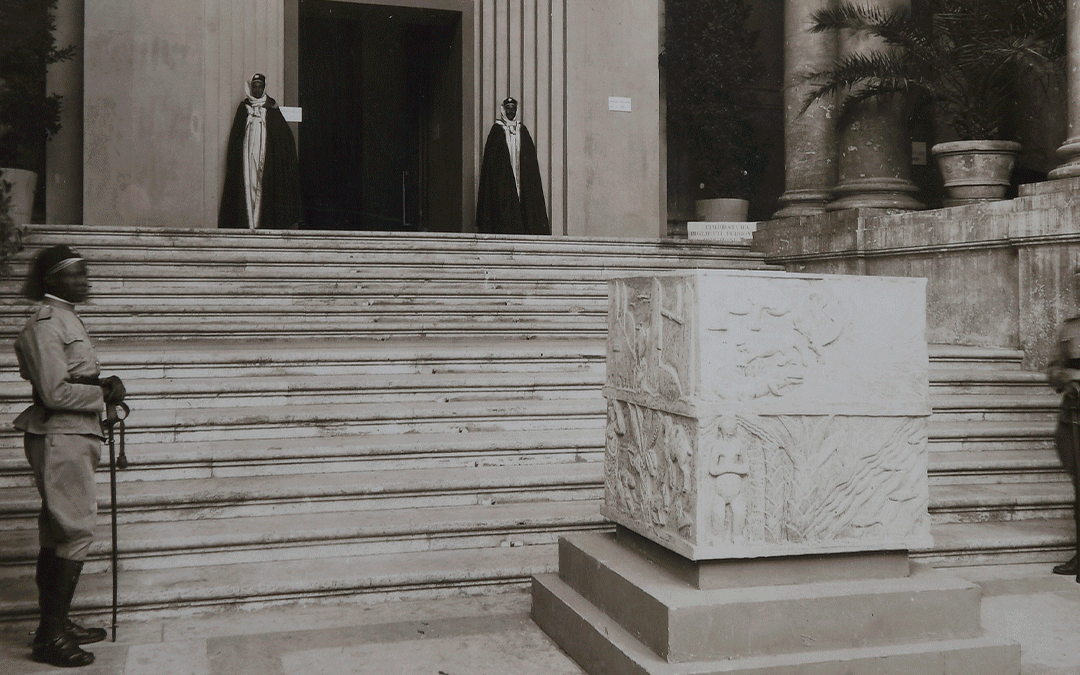
The curatorial approach and exhibition methodology echoes the layering of documents and artworks from the first chapter of Museum of Opacities. It presents a selection of photographic documentation from main colonial exhibitions—both national and international, covering both art and trade—held in Italy, from the 1914 International Exhibition of the Navy and Hygiene in Genoa to the First Triennial Exhibition of the Italian Overseas Territories in Naples in 1940, which later traveled to Rome, Milan, and Bari. This evidence of the widespread and consistent presence of public displays promoting colonization challenges the belief that Italians were largely unaware of developments in the colonized territories. Moreover, the juxtaposition of these materials with works produced in the field by artists—from both Italy and the Horn of Africa—as well as with photographic dossiers and objects from the colonial collections, reveals how these exhibitions functioned as tools for shaping and manipulating the narrative of colonization, highlighting the need to revisit and clarify the history of Italian colonialism.
The artworks from the historical collections of the former Colonial Museum include pieces by the artists Domenico De Bernardi, Gariesus Gabret, Laurenzio Laurenzi, Giorgio Oprandi, Yohannes Tesamma, Giustino Varvelli, Teodoro Wolf Ferrari, and Yitbārak. These works, carried out in a range of mediums, are presented in dialogue with two contemporary pieces from MUCIV’s collections: Peter Friedl’s sculpture Tripoli (2015) and Adelita Husni-Bey’s textile map Montagna verde (2011). Husni-Bey is also participating in the Sharjah Biennial 16 in the United Arab Emirates, on view through June 15, 2025, with her new video installation Like a Flood (2025), which was acquired by MUCIV through the Italian Council fund of the Ministry of Culture and coproduced in collaboration with the Sharjah Biennial.
Throughout the exhibition, informative displays contextualize the presented materials within the broader framework of Italian colonial history. A program of guided tours, educational activities, and public events offers further opportunities for discussion.
________________
Cooking Sections, Rights to Seeds, Rights of Seeds
The project Rights to Seeds, Rights of Seeds responds to the collection of seeds and agricultural products from the former Colonial Museum of Rome presented within the exhibition Museum of Opacities #2: Colonial agricultures and architectures. This project by Cooking Sections—a London-based collective founded by Daniel Fernández Pascual and Alon Schwabe in 2013—preserves seeds from 125 different varieties of vegetables from Southern Italy that are particularly resilient to rising temperatures and drought. Stored in ceramic jars inspired by traditional Southern Italian seed containers, the seeds have glazed with the ashes collected from the remains of seeds and the branches of olive trees affected by Xylella fastidiosa, a bacterium that has devastated olive monocultures in southern Puglia. Twice a year—during sowing and harvesting seasons—farmers are invited to bring additional seeds to MUCIV to exchange with those in the jars. This transforms the museum into an active space for the free circulation of these seed varieties.
With the goal of establishing a long-term collaboration with the network of farmers who preserve these seeds, the Museum has signed a “seed exchange protocol” that formalizes the guardianship of these unregistered seeds to protect them from ownership claims, patents, and commercial restrictions. Thus, Cooking Sections’ intervention also invites broader reflection on the implications of the “rights of nature,” beginning with the seeds themselves. These seeds remain unowned and uncommodified, circulating within a living collection guaranteed by the Museum of Civilizations.
DAAR – Sandi Hilal and Alessandro Petti, Entity of Decolonization: Ashes
Ashes is a new phase of the ongoing project Entity of Decolonization. It emerges—quite literally—from the ashes of a copy of Entity of Decolonization (2022), an installation by DAAR (Decolonizing Architecture Art Residency), a collective founded by Sandi Hilal and Alessandro Petti in 2007, based between Palestine and Sweden. The original installation was exhibited on the terrace of the Palace of Sciences at MUCIV – Museum of Civilizations. In May 2024, the replica was burned during a collective ritual at the former Entity for the Colonization of the Sicilian Latifundium in Carlentini (Province of Syracuse). The resulting ashes are now contained in eighteen amphorae, each intended to “fertilize” a new project. This approach continues the reflections initiated by Entity of Decolonization, critically engaging with the legacy of difficult heritage—fascist, colonial, and modernist—and exploring the collective imagination of new possible applications and interpretations of these histories. For Ashes, DAAR has reassembled two display cases from the former Colonial Museum of Rome, subverting their original function of displaying products of colonialism. The vitrines have been transformed into a device for sharing a video that illustrates the transformation of the colonial entity into a decolonization entity.
As DAAR’s work demonstrates, Italy contains a significant architectural heritage from the colonial period (1882–1960), much of which has yet to undergo a conscious decolonization process. Thus, from the ashes, another initiative is born: the Prize for the Critical Reuse of Difficult Heritage, a new collaboration between DAAR and the Museum of Civilizations. The inaugural award was granted to the Municipality of Carlentini in recognition of its support for the reuse of Borgo Rizza colonial structures. Together, DAAR and the Museum aim to recognize the value of individuals and projects that reorient this difficult heritage toward new interpretations and uses to generate further shared, transformative possibilities.