

Rights to Seeds, Rights of Seeds
Description:
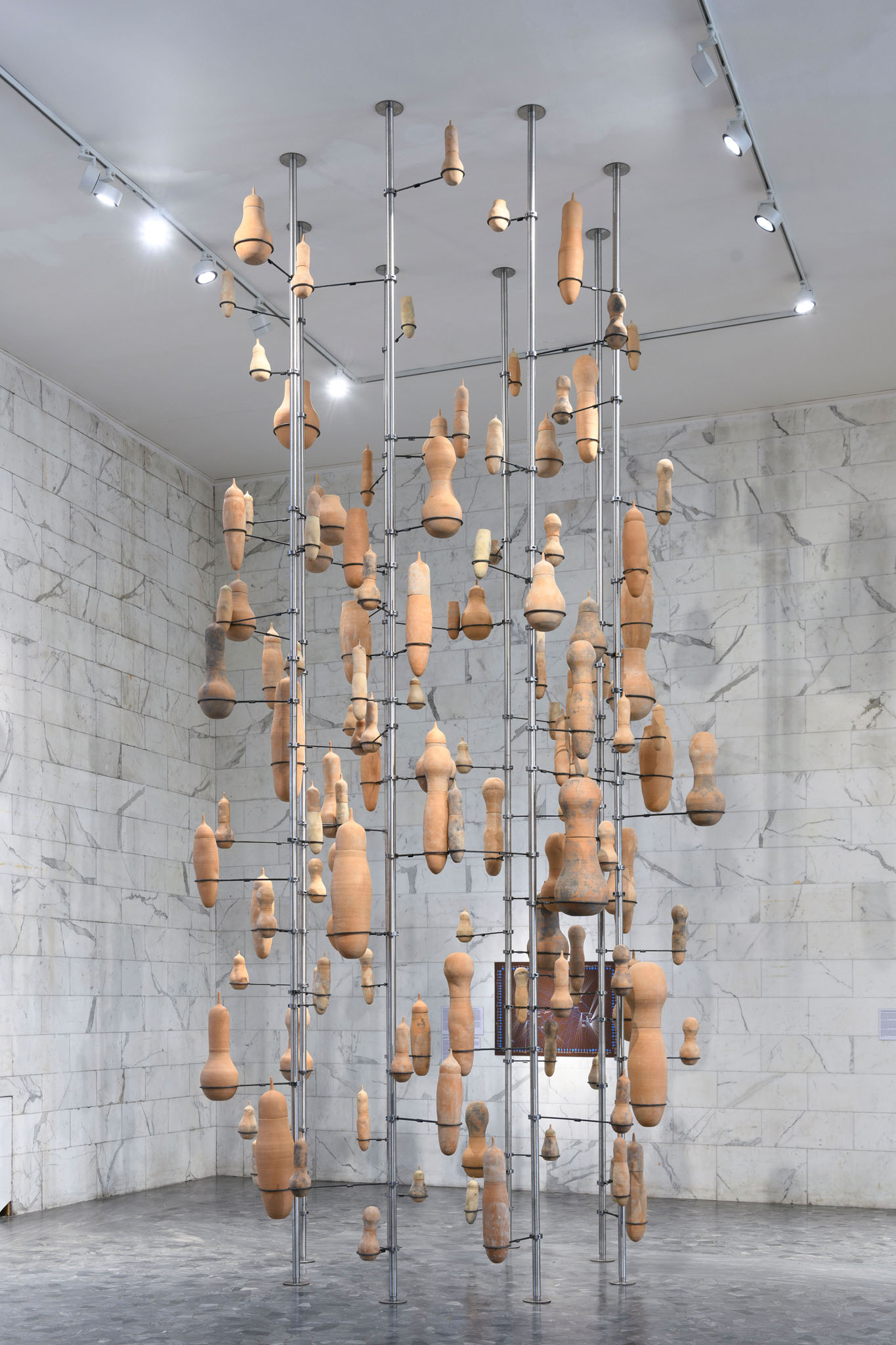
The installation Rights to Seeds, Rights of Seeds by Cooking Sections (founded in London in 2013 by Daniel Fernández Pascual and Alon Schwabe) enters into dialogue with the collection of seed and agricultural products of the former Colonial Museum of Rome, connecting historical narratives with the urgencies of the present.
Through CLIMAVORE x Jameel at the Royal College of Art (RCA), Cooking Sections is currently collaborating with 40 farms and cooperatives in Puglia and Sicily—two of the most arid regions in Italy. The artists’ work invites reflection on the importance of confronting the historical legacy of extensive monocultures tied to colonial agriculture, while also preserving rare and native seeds in the present. Among these are 125 unregistered seeds from various vegetable varieties from southern Italy, resilient to rising temperatures and drought, which are used in the installation. These seeds are stored in ceramic jars inspired by traditional southern Italian seed containers, glazed using ashes collected from the remains of seeds and branches of olive trees dried out during the spread of the Xylella bacterium, which devastated olive monoculture in southern Puglia. Once deposited, the seeds will be exchanged by farmers during two annual events—one linked to sowing and the other to harvesting—held at the MUCIV – Museum of Civilizations. In this context, the Museum has established an annual “seed exchange” protocol, which formalizes the custodianship of unregistered seeds and allows them to remain free from claims of ownership, patents, restrictions, or commercial interests. In doing so, the museum becomes an active platform that fosters both historical reflection and the free circulation of contemporary seeds, functioning as a space-time of natural-cultural repair, and recognizing Italian agricultural heritage and its traditional knowledge not merely as something to preserve, but as something to keep alive in the present. The installation by Cooking Sections thus offers an opportunity to engage in broader reflection on the various implications of the “rights of nature”, beginning specifically with the rights of the seeds deposited and circulated through the installation itself. ML