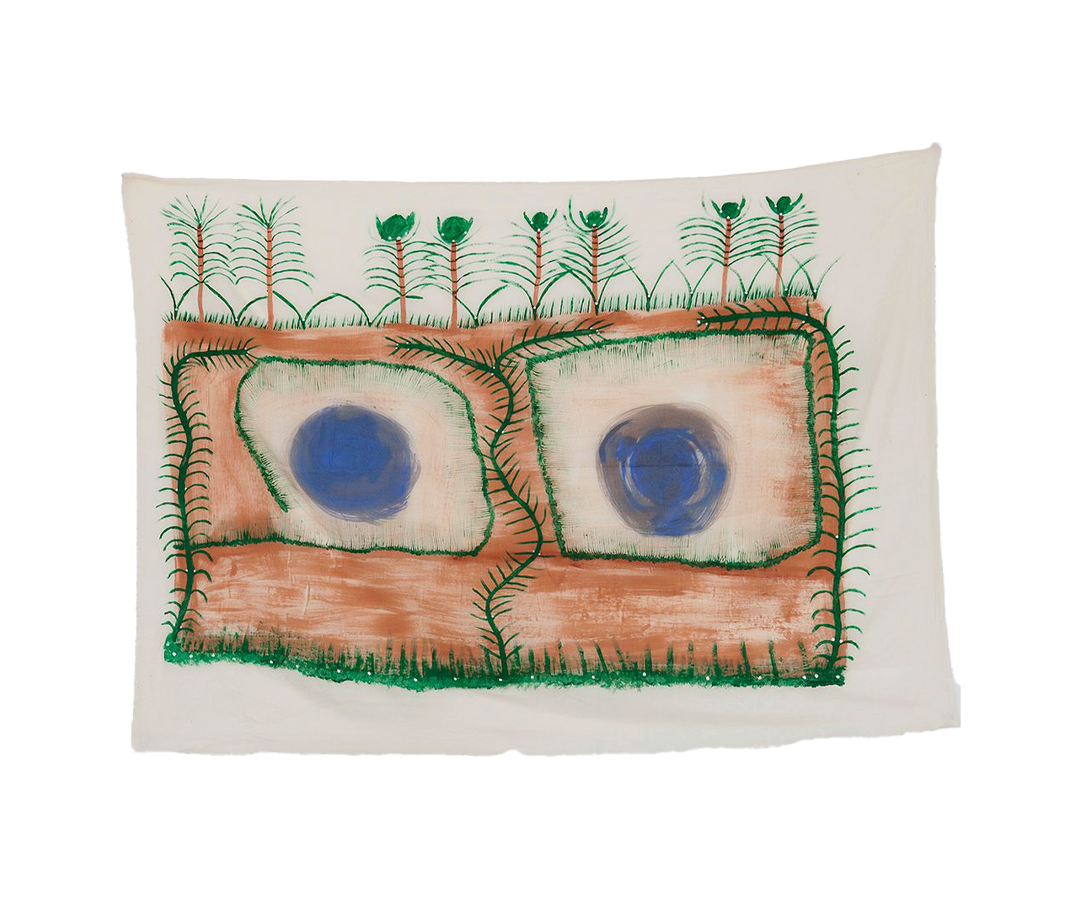


Wawe wawe aresi (The lagoon is dry)
Description:
Sheroanawe Hakihiiwe (1971, Sheroana, Venezuela), a native of Sheroana—a small community in the Upper Orinoco in the Venezuelan Amazon—draws on the graphic and mythological traditions of his people, the Yanomami, transforming ancestral motifs that survived colonization into contemporary signs suspended between abstraction and symbolic narrative. His work begins with the creation of paper, handmade from natural fibers, a technique he learned from Mexican artist Laura Anderson Barbata, who visited that region of the Amazon in the 1990s for several community projects and passed on her knowledge of papermaking to Hakihiiwe. Wawe wawe aresi (La laguna está seca) (The lagoon has dried up) translates the fragility of the Amazon’s ecological and spiritual balance into a visual language shaped through the gaze and aesthetics of the Yanomami. Essential, almost calligraphic strokes evoke the arid land where the lagoon once lay. The pictorial surface becomes a space for reflecting on loss and the absence of water—an environmental crisis that also serves as a metaphor for a broken bond between human beings and the forest’s spiritual dimension, for a memory that dries up alongside water resources as the Amazon rainforest is devastated by mining, the rise of intensive farming, and the expansion of industrial agriculture. In this work, Hakihiiwe reclaims the continuity between art, land, and Indigenous cosmology. His pictorial gesture restores dignity to the Yanomami visual language and transforms the work into an act of witness and care for his land, offering a poetic representation of an environmental wound that he chooses to commemorate, in the hope that water may one day return to the lagoon. ML