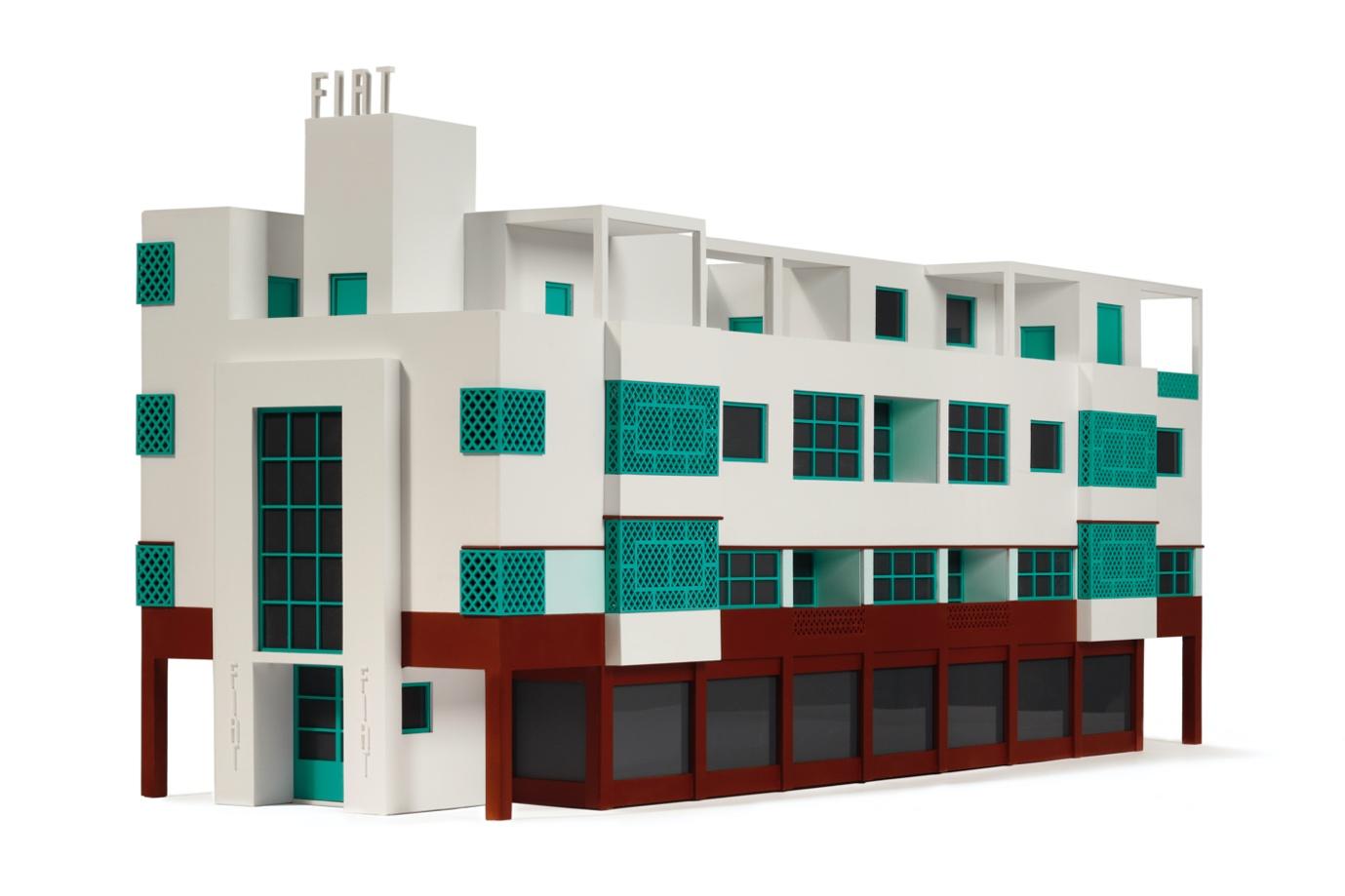


Tripoli
Description:
In his 2009 essay “Secret Modernity,” the artist Peter Friedl (b. Oberneukirchen, 1960; lives and works in Berlin) explores the historical links of Italian colonialism from the late 19th century to 20th century futurism, modernist and rationalist architectural theory, and neorealist cinema. Friedl incorporated reflections of writers such as Pier Paolo Pasolini on the continuity between “archaeological” or “traditional” fascism and the consumer society of his time. In Tripoli, Friedl materializes a never-built architectural project originally designed for the Libyan capital during the Italian occupation. The design, by the architect Carlo Enrico Rava — who, in 1926, cofounded the collective Gruppo 7 alongside Giuseppe Terragni, which sought to merge the rationalist principles of modernism with Mediterranean classical traditions — was intended to house the Tripoli headquarters of the FIAT automobile company. Rava’s proposal combined elements of local Libyan architecture and the modernist language of Gruppo 7.
By giving form to this unrealized structure, Friedl reveals the ideological framework that links modernist aesthetics, industrialization, and extractive economies with colonialism, while highlighting the complicity of Italian industry in sustaining colonial occupation. In Costruire Colonia, Terragni declared: “The first and most important principle of urban planning is the separation of colonial architecture into two parts, with the natives on one side and the whites on the other.”
Friedl’s model of a building that was never constructed invites reflection on the impossibility of separating the aesthetic forms of architecture from their historical motivations. This inquiry resonates with Rome’s EUR district, where MUCIV is located. ML