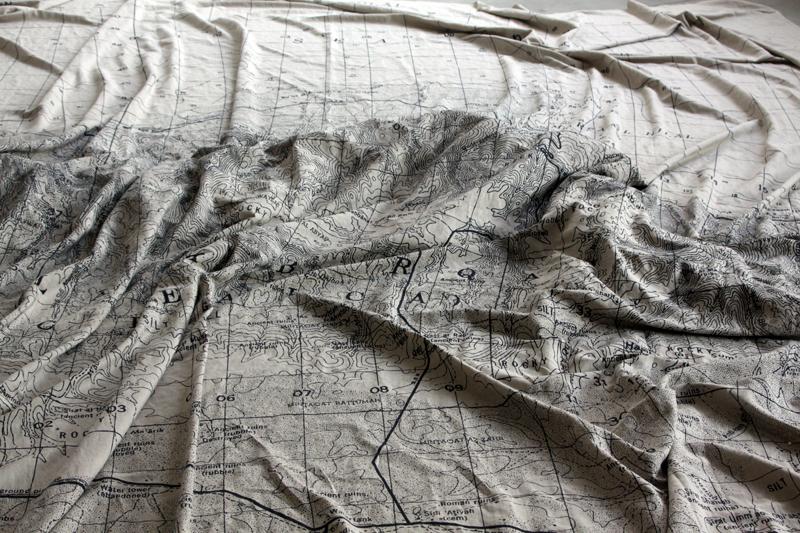


Mappa (dalla serie La montagna verde) /Map (from the Series The Green Mountain)
Description:
The large fabric map displayed on the wall depicts the al-Jabal al-Akhdar plateau (الجبل الأخضر or Green Mountain) in the Cyrenaica region of Libya. This area was the site of numerous conflicts during the Italian colonial occupation, which lasted from 1912 to 1943. It is also a place of personal significance for Italian Libyan artist Adelita Husni-Bey (b. 1985, Milan; lives and works between Bologna and Modica). For La Montagna Verde (The Green Mountain), the artist retrieved a military map from the archives of the Geographical Institute in Paris, which she stripped of its colonial designations, leaving visible only the archaeological sites, water sources, and oases. She printed this revised map on fabric that resembles the cloths she and her family would lie in the grass on during childhood visits to al-Jabal al-Akhdar.
The artwork converses with the nearby relief model of the Luigi di Savoia Village, one of several colonial agricultural villages built in the region. These settlements disrupted centuries-old harmonious relationships between local communities and the natural environment, which start to reemerge through Husni-Bey’s removal of imposed features from the fabric print. With the same intention of freeing the land from the colonial gaze that forced an identity upon it, the artist splits a historical photograph—an image originally created to satisfy European orientalist aesthetics—and balances its two halves on a stone collected from the region. This same landscape served as refuge for Libyan resistance fighters, including during the 1969 coup d’état that brought Muʿammar Gaddhafi to power. The intertwining of the artist’s personal memories—which inspired these two works—with the displayed objects forms a counter-narrative of resistance to the various forms of domination to which Libya has been subjected, and whose consequences the country is still suffering from. ML